Posts

Erenumab and other CGRP receptor antagonists- potential for action against brain tumours?
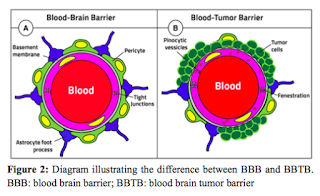
Image
At the moment I'm keeping an eye on trial results and emerging research of this relatively new medication (Erenumab) for episodic migraine to understand how it could have anti-cancer activity against angiogenesis in malignant brain tumours. Furness and Wookey, 2012 Erenumab is a human monoclonal antibody against the calcitonin gene-related peptide receptor (CGRP receptor) and its primary use is for the prevention of migraine. This simply means that it acts as an antagonist for the CGRP receptor. CGRP comprises of 37 amino acids and is produced in the peripheral and central neurons. The main function of this peptide is to transmit pain. Early studies in humans have shown that the drug could prevent migraines by up to 50% in phase 2 clinical trials (8) so wider spread use and future applications would be interesting to see. Long term safety requires further study as this is a relatively new drug. Research into CGPR receptor antagonists have been in development over the last few year...
WORTH REPEATING!- Drug cocktail approach against cancer stem cell-like cells

Image
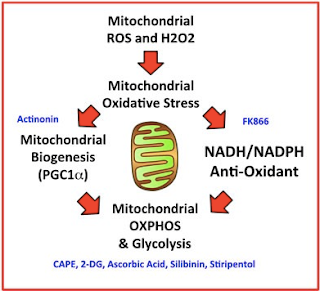
'Mitochondrial ROS and H2O2 production may be a trigger, for driving mitochondrial oxidative stress, ultimately leading to increased mitochondrial oxidative metabolism in CSCs. Pharmaceuticals, chemical inhibitors, or natural products that we have identified to target CSCs, which interfere with a specific metabolic process or function, are shown in BLUE.' https://www.ncbi.nlm.nih.gov/pmc/articles/PMC5400535/

Evidence for use of Stiripentol and other agents to effectively inhibit cancer stem-like cell activity.

Image
A few months ago (in March, in a previous post in my blog ), I theorised that stiripentol (the 'ketogenic diet pill') may be of use as an anti-cancer agent for brain cancer and perhaps others due to inhibition of Lactate Dehydrogenase activity. I think I have just found recent evidence that this theory may be valid. Stiripentol Stiripentol by Diatomit enhances beneficial effects of therapeutic ketosis for cancer management by inhibiting lactate dehydrogenase and offers neuroprotection and increased seizure threshold by enhancing central GABA neurotransmission. Here is an extra from the paper with reference to stiripentol and complimentary agents that could possibly offer a safe, synergistic therapeutic benefit. 'We have now identified a variety of clinically-approved drugs (stiripentol), natural products (caffein acid phenyl ester (CAPE), ascorbic acid, silibinin) and experimental pharmaceuticals (actinonin, FK866, 2-DG), that can be used to effectively inhibit cancer ste...

Probiotics experiment- VSL#3. Gut dysbiosis and cancer, epilepsy.

Image
I am currently on day 5 of a 30 day experiment using myself as a human guinea pig to test these high potency probiotics from Visibiome. I first heard about this product from Dr. Rhonda Patrick and I trust her judgement. She stated how Visibiome contains 8 strains of live bacteria in concentrations of 450 billion bacteria per packet and I had this confirmed by the company that produces it.  Why is this so important? This is impressive as many probiotics only contain about 100 million bacteria (often dead as they should ideally be kept cold). I decided to investigate further and try these probiotics myself to see if I may benefit so I contacted the sister company based in the U.K. (Vivomaxx).  The gut micro biome. You are only 10% organically human. (9) Let's begin... I received them promptly in pill l form, placed in an ice packed package. I chose the capsules because the carbohydrate content is negligible so should not interfere with my ketogenic diet to manage my epilepsy. I ...

Biochemical individuality. Thoughts on the effectiveness of dichloroacetate as an anti-cancer agent from DNA testing and analysis

Image
I have been using Prometheus to extract raw data from my 23andme raw data in an attempt to personalise my approaches moving forward. You can find out more here:  https://promethease.com https://www.britannica.com/science/DNA Interestingly, following on from my post about DCA, I decided to determine what SNPs I had relating to specific nutrients, metabolic therapies, and drugs. I have explored this before, but not in as much depth as I have recently. From pouring over the exhaustive amount of data detailed in my Prometheus report I found that I appear to be a slow metaboliser of DCA, which is interesting for a number of reasons. DCA is an interesting chemical compound, because it can be a chlorine byproduct from chlorinating swimming pools and tap water, and the 'poison' could be in the dose, with some arguing that it may be a major environmental hazard, or a 'panacea for human ills'- This has not yet been proven definitively either way, as the study below has concluded,...

DCA and glioma

Image
Human glioblastoma patients require at least a 6.25 mg/kg oral, twice-a-day dose of DCA (Dichloroacetate) to inhibit PDK (Pyruvate dehydrogenase kinase) and kill cancer cells as indicated in the study below (5). http://artemisinin.pbworks.com/f/Metabolic+Modulation+of+Glioblastoma+with+Dichloroacetate.pdf A reliable source of DCA can be found here: https://www.dcalab.com It comes in tablet form as well as a powder. The main problems I see here is that you would need to have enough of the product to get the appropriate therapeutic dose and it is not cheap! Simple background as to why DCA might be useful: As many reading this will already know, most tumours display unique metabolism described as the 'Warburg Effect' which has long been associated with the resistance to apoptosis which characterises cancer. Even in tumours where glucose is maybe not the primary fuel, it appears to still play a key role as a major energy source.  the Warburg Effect (9) Cancer is clever, there are p...